
As our training has been tapering down, we’ve been finalising our food plans for during the ride – I’m writing this down here to clarify our thoughts about it and summarise all we’ve read before it pours out of my brain; feel free to skip this post if it’s a bit dull. But not before you admire another of my patented cartographic gems:

During our training we’ve tried all the different things we’re likely to eat, what we need to calculate is exactly how much and how often. This is one of the more difficult things to get right about cycling so far in a limited time, hence our careful planning. We’ve tried a few different patterns of eating, with varied success, and done a lot of reading on the best practises to follow. There are links to a few of these articles at the end of this post.
How much?
The general consensus for a 4+ hour ride is to target 1g carb per kilo body weight per hour riding (so 60-80g, 240-300 calories), without too much fat and protein. That’s the limit of what you can process usefully – more than that can make you feel highly uncomfortable without any additional benefit. With that said, we’ve tended towards not eating enough during training so overdosing is unlikely to be a problem.
We’ll be burning 450-600 calories an hour, with the amount above what we can eat coming from the reserves we start with and, if those run out (technically if we “reach full carbohydrate depletion”), burning fat. Burning fat may sound good but it’s a slow process which can’t supply energy quickly, seriously affecting performance. At this point, the lack of available glucose muddles your brain and just turning the pedals becomes very hard work hence the name for reaching this stage in common cycling parlance: “bonking” or “the bonk”. Once you get to that point, it is incredibly difficult to recover while continuing, so avoiding it is key.
So, while we don’t need extra energy in the first hour or so (our hearty breakfast will fuel that) it’s very important that we eat right from the start to preserve our stored energy for later in the ride. Our breakfast will be around two hours before the start, largely slow-burning porridge, then a banana about half an hour before the start which seems very widely recommended.
What?
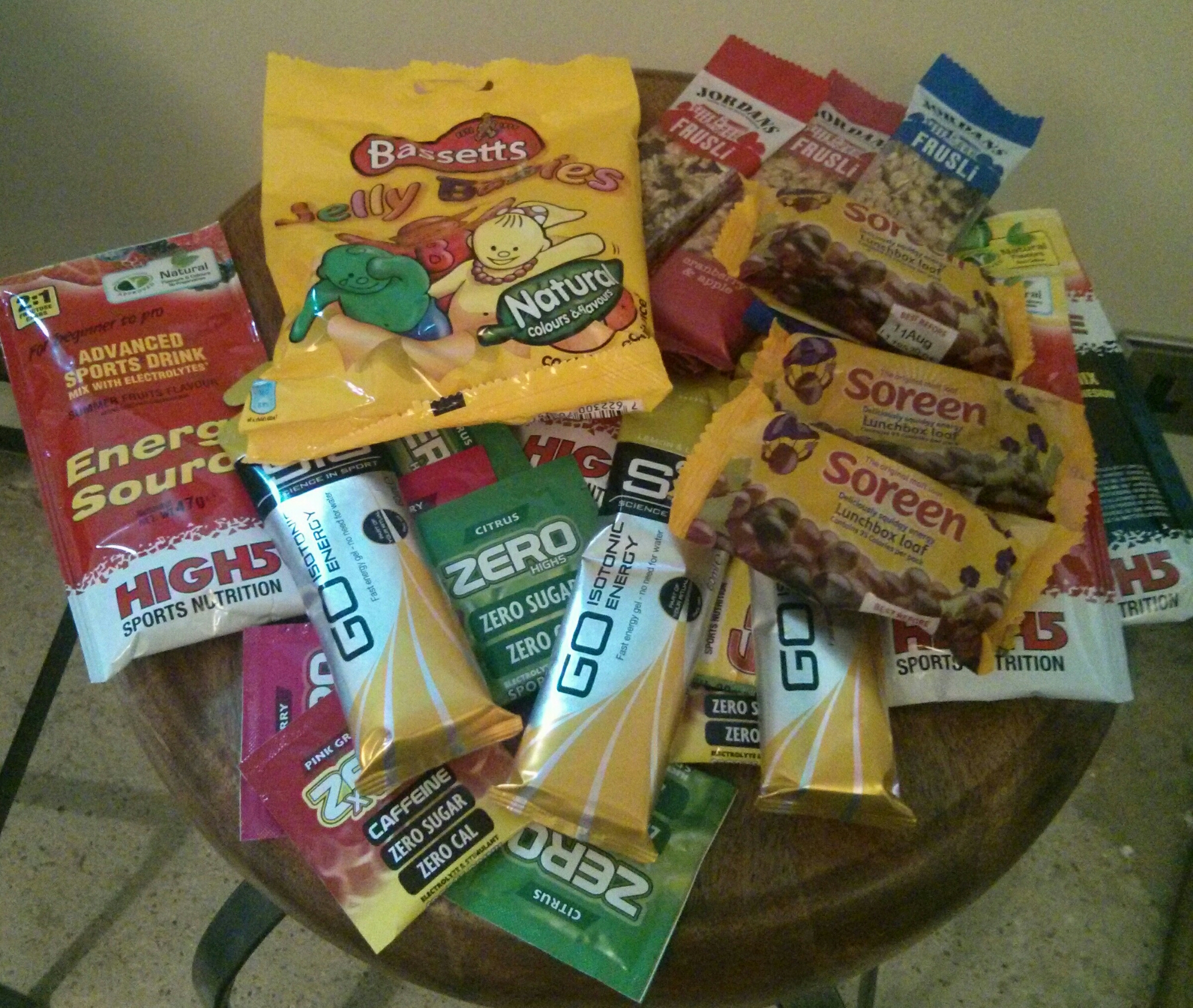
We’re not big on the technical sports energy products (gels and what have you), preferring real food where possible and saving gels for near the end. So our mainstays once we’re on the road will be:
- Frusli cereal bars (21g carbs each)
- Malt loaf (19g carbs for a mini loaf)
- Fig rolls (a.k.a. fig newtons in the US, 12g carbs each)
- Maybe the odd banana if we can work out how to carry (27g carbs in a medium one)
- Jelly Babies (5g carbs each)
- Haribo (all different sizes so harder to quantify, very approx 2g each)
Combining these up gives various options to reach the 60-80g/hr target, and we’re going to try and eat a little something every 15-20 minutes, with one bigger thing per hour (for example, 3×3 jelly babies then a frusli bar would be 66g carbs).
It’s likely to take us around 7-7.5 hours to do the distance, and for a ride that long many recommend having a stop (of no more than ten minutes) to eat something more substantial around 3.5 hours in – if nothing else, the physical hunger of going 7.5 hours with only snacks can be quite significant, and the energy and psychological boost of having a few minutes off the bike is also useful – though not too long or your muscles cool off.
We’ll look to do that around Newlands Corner (the first major climb of the route, around 45 miles in) – probably having some jam sandwiches with a nice bit of Battenberg cake (any excuse for cake…). About 15 miles after this point, we’ll hit Leith Hill, so that should give the extra food time to get into our systems and help power us up there!
After that, we’ll continue with the 2-3 little-somethings plus one bigger thing per hour plan through to the end, though increasingly switching in the technical sports foods – gels, energy drinks, etc – as they’re the easiest to digest and provide more of an instant boost. They’re also what’s available at the drink stations along the route and carrying all of this lot may prove impossible.
Foods we’ll have available for later in the ride will include:
- Science in Sport isotonic gels (22g carbs each, a few carried)
- High 5 Energy Gels (23g carbs each, at later drink stations)
- High 5 Energy Source (44g carbs per sachet / per 500ml mixed, at most drink stations plus one or two carried)
- … plus whatever we have left of the above from earlier.
As we near the end (maybe in the run up to Wimbledon Hill), we’ll have a gel with caffeine to give us an extra boost for those final few miles.
Something to drink with that?
The other major factor we need to consider is hydration. Throughout our training we’ve been using Nuun and High 5 Zero, both of which supplement water with the electrolytes vital to replace lost salts when sweating lots, but adding no energy. We’ll continue with this as it has worked well, carrying a few high 5 zero tablets so we can quickly mix our own if only water is available when we need to refill. In the later stages, we will likely switch to one High 5 Energy Source bottle and one Zero bottle to cover hydration and energy at the same time.
It’s hard to plan in advance how much to drink as the need varies significantly with the ambient temperature, but most recent research seems to suggest that drinking to thirst (or just ahead of it) is the best strategy. It’s surprisingly easy to over-hydrate and that can have serious consequences, although if it’s hot that’s less likely to be an issue. You do need a decent amount of hydration to ensure you can process the carbs, though… A hard one, but we feel that on most of our long training rides we’ve done OK with this, so we’re not too worried.
If you’ve any thoughts or tips or questions, do leave a comment!
Here’s a few of the useful articles we’ve read while looking in to all this: