Just a very quick update now as we’re running round like mad things getting ready for the morning.
To keep up with our progress tomorrow, come rain or shine, the newly-upgraded laser-powered SheepTracker is now online – go to http://markandaudrey.co.uk/sheeptracker/ and see us pootle along in real time, with fancy stats and what have you. Audrey’s phone is a little less reliable than mine at sending its position, so if she disappears for a while, don’t worry too much!
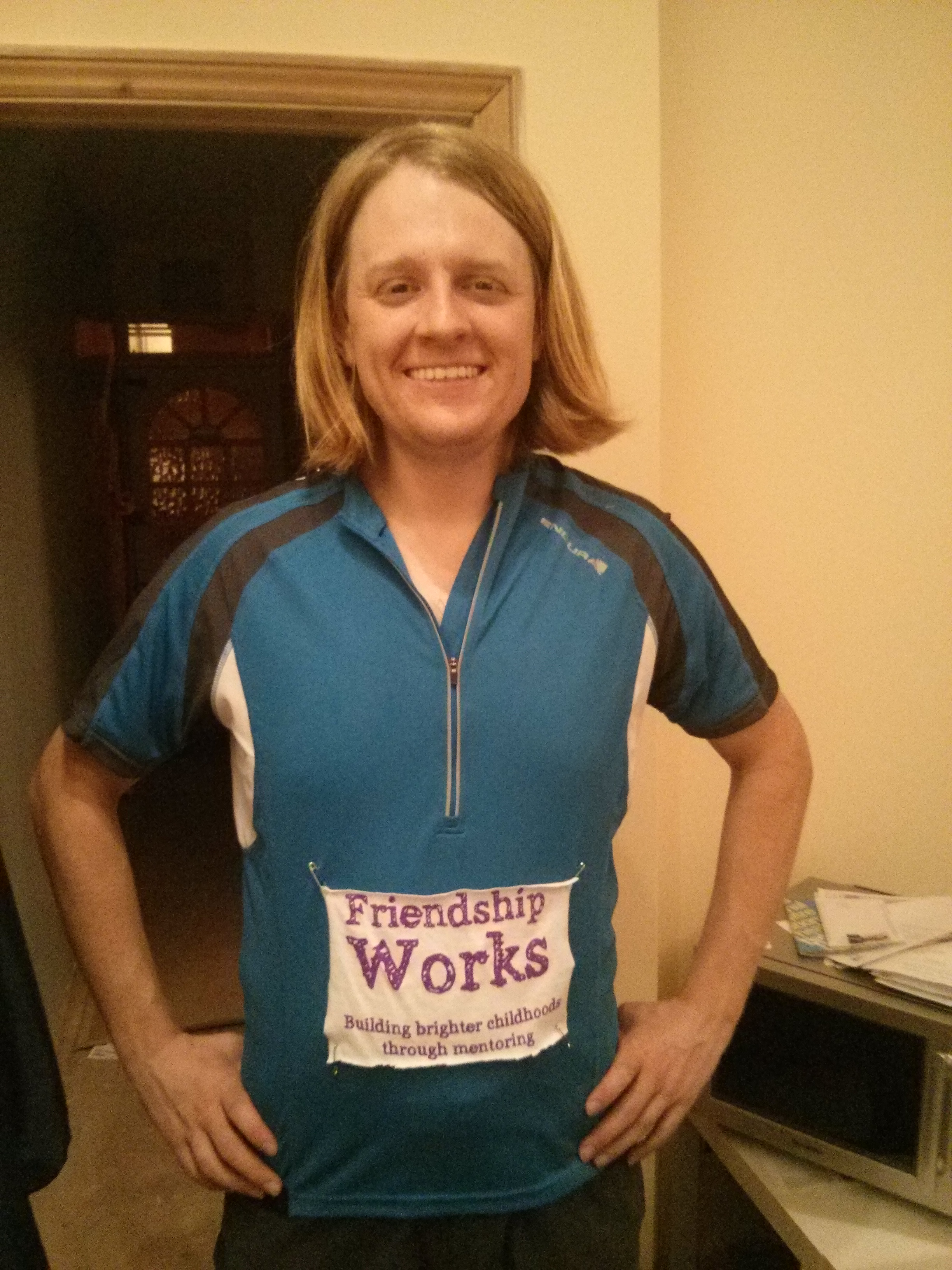
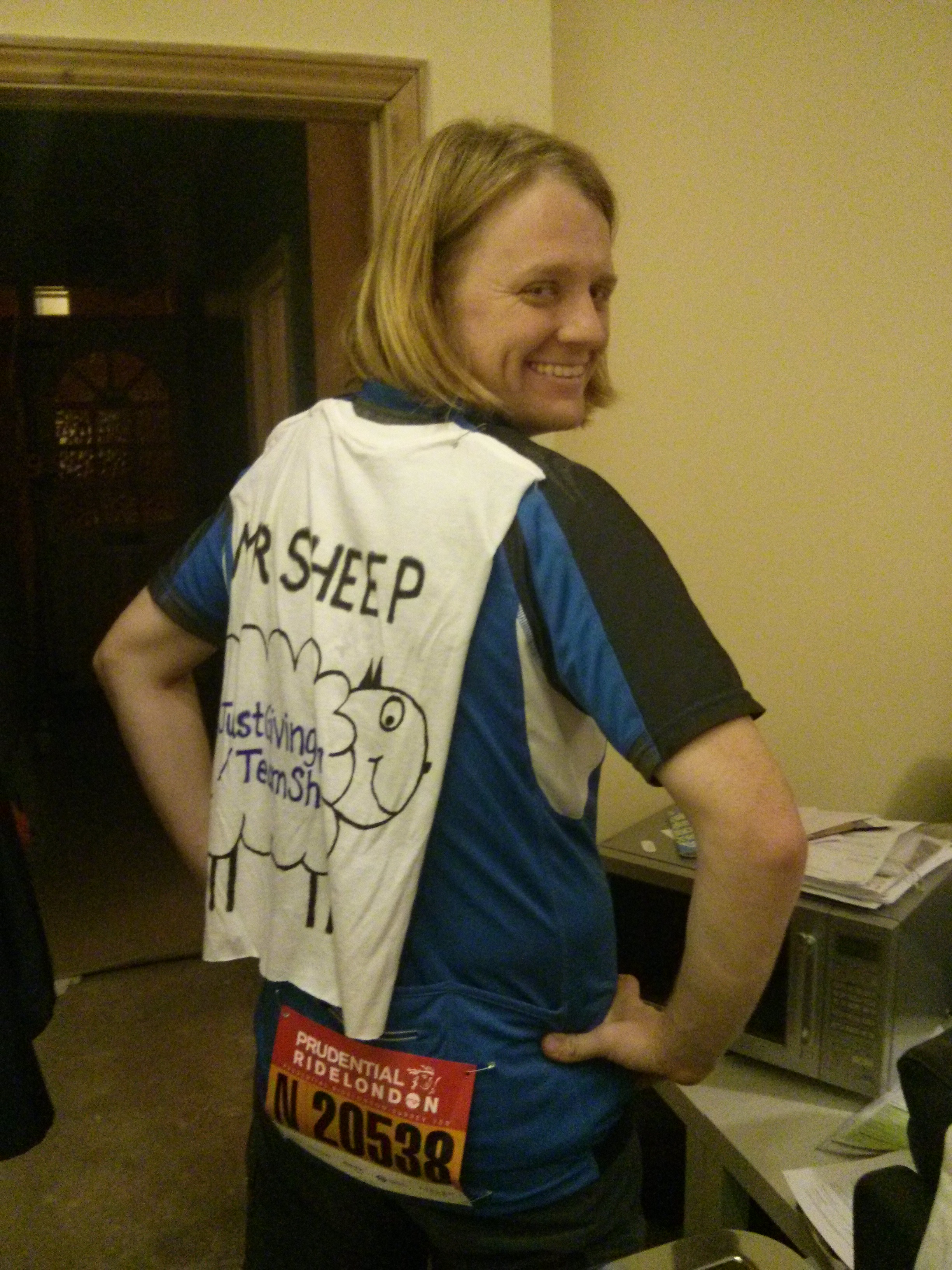
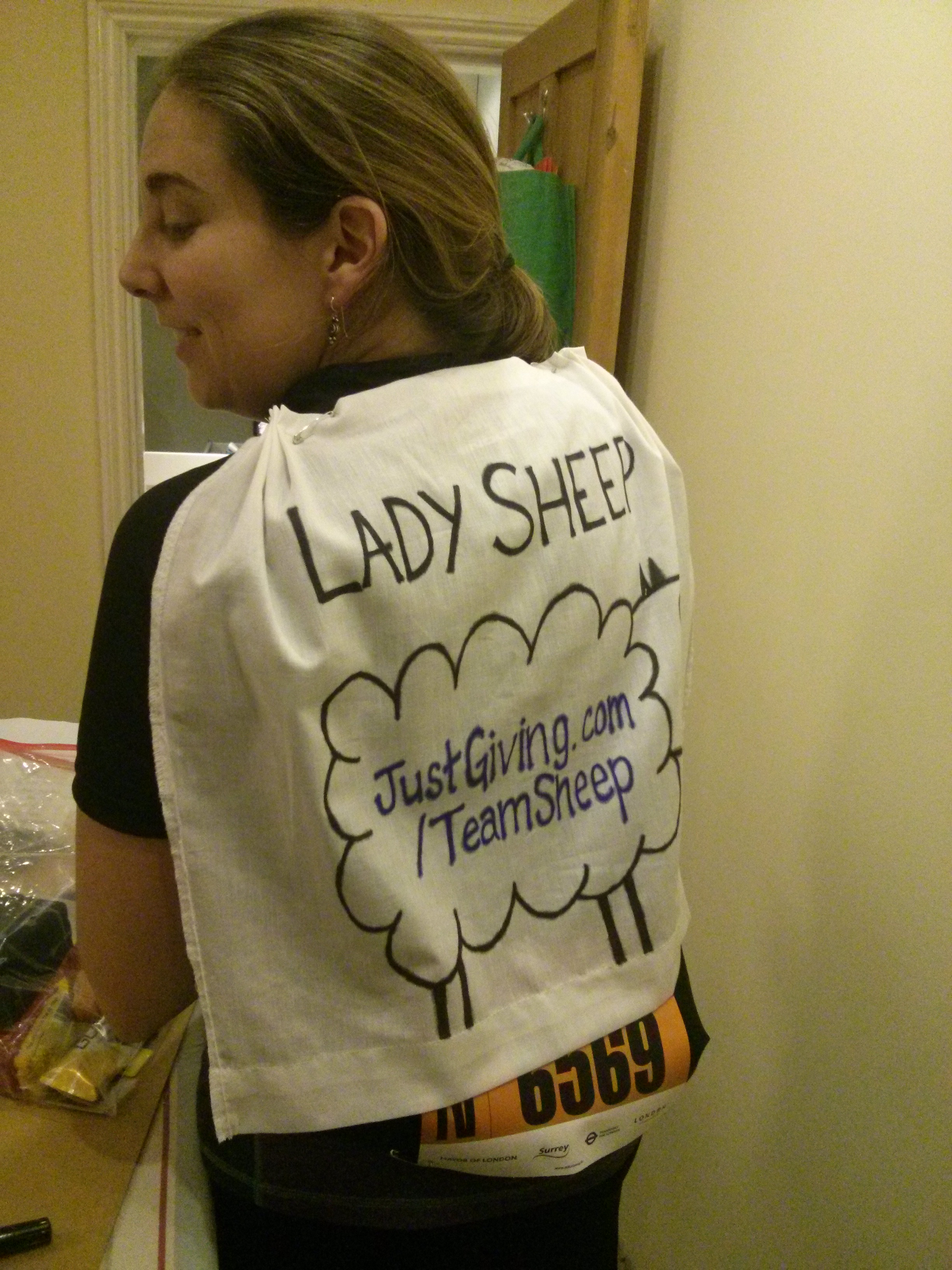
We’ve got our Team Sheep capes at the ready, and jelly babies coming out of our ears. Let’s do this thing!
If you’re planning on coming to see us at any point, the route is below (click for a full interactive map). If you want to wish us well, or you’re coming along to see us during the ride, you can drop us a message (to Mark on Whatsapp / Hangouts / Facebook Messenger, or @sheeponbikes on Twitter) – let us know where you’ll be and we’ll keep an eye out for you!
In which Mark gets sentimental about cycling in London…
This weekend, after many months of training, we will cycle 100 miles through London and Surrey in less than eight hours. But the process didn’t start with the training. In 2007, I was the most unfit, most out-of-shape I’ve ever been, when a wondrous thing came to London one Sunday: the Hovis Freewheel.
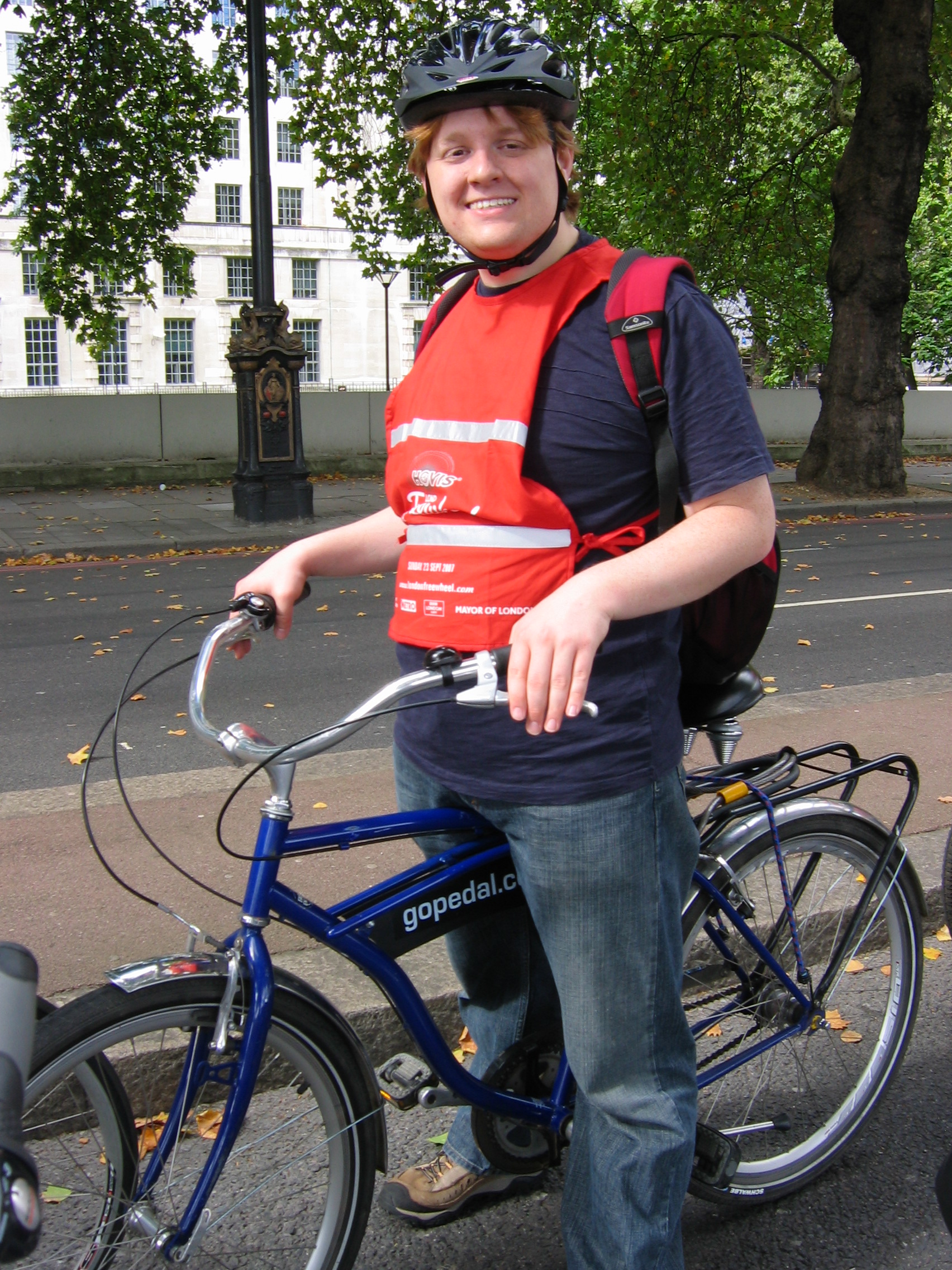
Before: At the Hovis Freewheel, September 2007
Closed central London roads with led rides in from various outer London points, it was the spiritual predecessor to the Ride London weekend. Audrey suggested we go along (she is wonderful for making sure we do these things) and although I’d not turned a pedal in well over a decade I jumped at the chance. Registering for the event, we got our shiny red tabards, hired bikes, and cycled in from the hub on Clapham Common.
We had a wonderful time, getting carried away with the pure joy of zooming along iconic central London roads without any traffic to worry about, completing lap after lap of the 8.5 mile route. We pushed it rather too far and caused ourselves some knee troubles in the process, but it was an eye-opening experience.
A few years passed; we flirted with the gym for a while, I made some small fitness gains, nothing major or consistent. Then, in the summer of 2010, a strip of cycle lane appeared outside the station where we embark on our daily tube commute. Cycle Superhighway 7 had arrived, stretching from Colliers Wood to the City of London – my commute represented in sky blue paint on the road. Even my inexperienced non-cyclist eyes could see the paint provided no useful cycling space (particularly through Tooting where it’s mostly under parked cars), but it highlighted that it was conceivable for me to cycle to work, which I hadn’t considered before. Looking into the practicalities of it, I found multiple routes I could take (thanks Cyclestreets!), each around ten miles. That sounded like A Very Long Way – but achievable, at least occasionally.
Around this time, the cycle hire scheme (aka ‘Boris Bikes’) also launched in central London, giving me a first taste of cycling on the open roads of our city. Frankly terrifying the first few times, for some reason I stuck with it… the freedom, the joy of the activity, the joining up of the places previously only connected by a coloured line on the tube map. The city started to open up, the sights along the way so much better than tunnels covered in inches of brake dust.
I finally got myself a bike in the summer of 2011 (a Specialized Sirrus hybrid), taking Merton’s rather good free adult cycle training before venturing the whole way in to work. By the autumn I was cycling to work occasionally, working my way up to 3-4 times per week. And to this day, cycling across Clapham Common in the morning mist or seeing the vista of London open up wide across the horizon in front of me when crossing Southwark Bridge is a buzz every single time.
Several thousand miles of commuting and cycling around London later, the foundations for the fitness required for this coming weekend were well laid. But more importantly, the foundations for a healthier life – for the first time as an adult I’m getting enough regular exercise, maintaining a healthy weight. And unlike trudging away at the gym, it’s mostly a joy to do.
After: at the London Nocturne Barclay’s Cycle Hire race – photo courtesy of Kevin Oakhill
So, thank you London – you wonderful, flawed metropolis. There’s so much to be negative about when it comes to cycling in this city, but for me, for my health, through flawed interventions like Cycle Superhighway 7, through great interventions like the Cycle Hire scheme, and through well-intentioned mass events like the Freewheel and its successors, London has worked wonders. Small enablers that prompt and allow a healthier lifestyle.
The city can, and should, be so much better for cycling, and there are encouraging signs that improvements are on their way. Hopefully we will see cycling becoming a more inclusive activity, more open to all, as these plans come to fruition. There are enormous health benefits of building activity into our lives in this way; benefits that are clear and well known and that spread out beyond the individual to society at large (the cost of treating obesity and its related illnesses in the UK is over £4bn a year).
But you don’t need to wait for things to be built – there are some great cycling routes to be had in this city already (ask me and I’ll help you find them) – and if I can go from a sedentary zero and borderline-obese to cycling 100 miles in a go (or, more to the point, thousands of miles per year) and a healthy weight in a pretty short time, then so can just about anyone.
And so to this weekend. 100 miles of beautiful closed roads as we Ride London. Tens of thousands of participants. Thousands more watching on the streets. Get on your bikes and join the party! Enjoy Saturday’s Freecycle on closed roads in central London, or work out how to start building a bit of cycling in to your lives. Once you start…
As our training has been tapering down, we’ve been finalising our food plans for during the ride – I’m writing this down here to clarify our thoughts about it and summarise all we’ve read before it pours out of my brain; feel free to skip this post if it’s a bit dull. But not before you admire another of my patented cartographic gems:
Our map, so we know what fuel we can get where!
During our training we’ve tried all the different things we’re likely to eat, what we need to calculate is exactly how much and how often. This is one of the more difficult things to get right about cycling so far in a limited time, hence our careful planning. We’ve tried a few different patterns of eating, with varied success, and done a lot of reading on the best practises to follow. There are links to a few of these articles at the end of this post.
How much?
The general consensus for a 4+ hour ride is to target 1g carb per kilo body weight per hour riding (so 60-80g, 240-300 calories), without too much fat and protein. That’s the limit of what you can process usefully – more than that can make you feel highly uncomfortable without any additional benefit. With that said, we’ve tended towards not eating enough during training so overdosing is unlikely to be a problem.
We’ll be burning 450-600 calories an hour, with the amount above what we can eat coming from the reserves we start with and, if those run out (technically if we “reach full carbohydrate depletion”), burning fat. Burning fat may sound good but it’s a slow process which can’t supply energy quickly, seriously affecting performance. At this point, the lack of available glucose muddles your brain and just turning the pedals becomes very hard work hence the name for reaching this stage in common cycling parlance: “bonking” or “the bonk”. Once you get to that point, it is incredibly difficult to recover while continuing, so avoiding it is key.
So, while we don’t need extra energy in the first hour or so (our hearty breakfast will fuel that) it’s very important that we eat right from the start to preserve our stored energy for later in the ride. Our breakfast will be around two hours before the start, largely slow-burning porridge, then a banana about half an hour before the start which seems very widely recommended.
What?
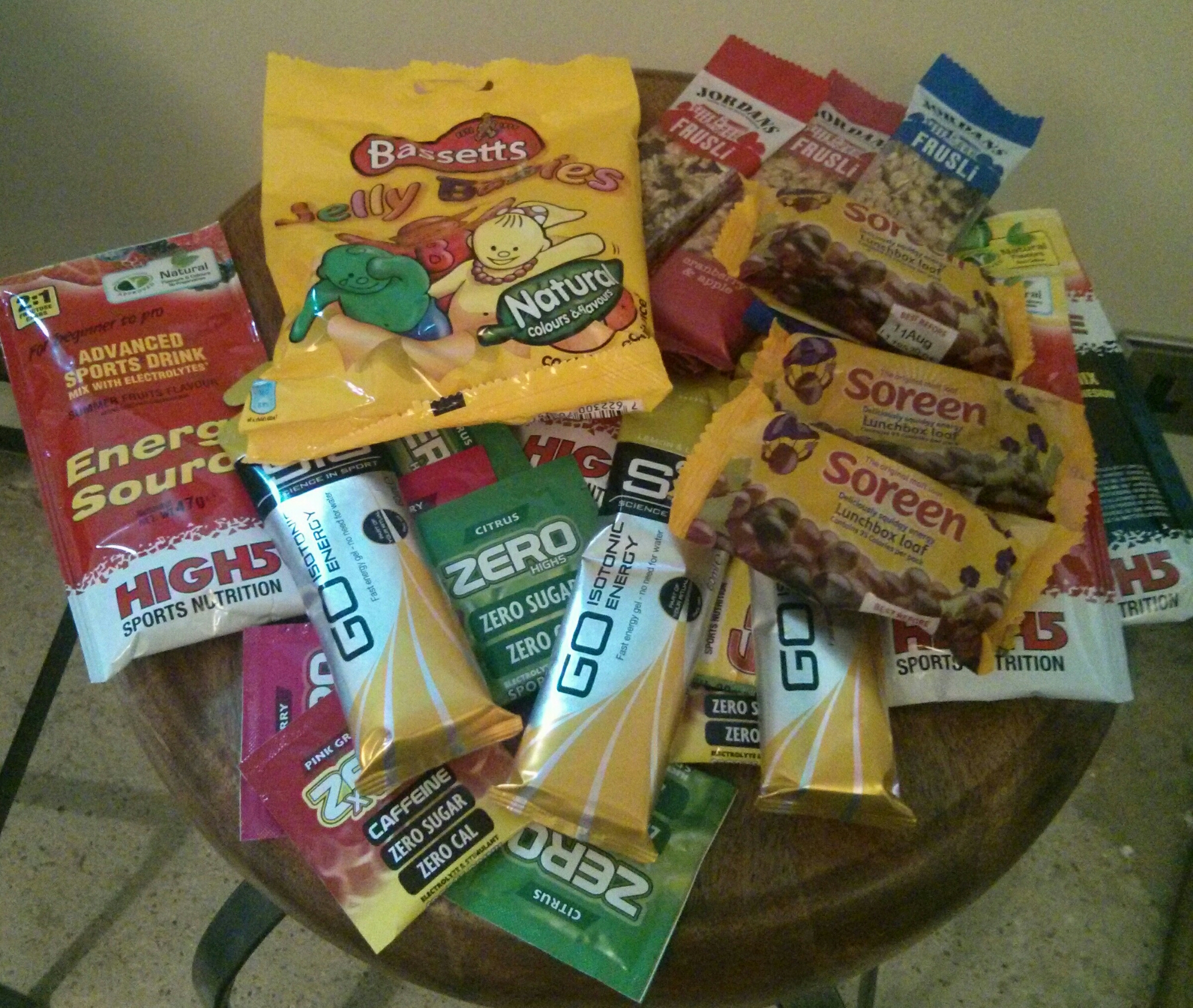
A small selection of the smorgasbord we’re intending to take along…
We’re not big on the technical sports energy products (gels and what have you), preferring real food where possible and saving gels for near the end. So our mainstays once we’re on the road will be:
Frusli cereal bars (21g carbs each)
Malt loaf (19g carbs for a mini loaf)
Fig rolls (a.k.a. fig newtons in the US, 12g carbs each)
Maybe the odd banana if we can work out how to carry (27g carbs in a medium one)
Jelly Babies (5g carbs each)
Haribo (all different sizes so harder to quantify, very approx 2g each)
Combining these up gives various options to reach the 60-80g/hr target, and we’re going to try and eat a little something every 15-20 minutes, with one bigger thing per hour (for example, 3×3 jelly babies then a frusli bar would be 66g carbs).
It’s likely to take us around 7-7.5 hours to do the distance, and for a ride that long many recommend having a stop (of no more than ten minutes) to eat something more substantial around 3.5 hours in – if nothing else, the physical hunger of going 7.5 hours with only snacks can be quite significant, and the energy and psychological boost of having a few minutes off the bike is also useful – though not too long or your muscles cool off.
We’ll look to do that around Newlands Corner (the first major climb of the route, around 45 miles in) – probably having some jam sandwiches with a nice bit of Battenberg cake (any excuse for cake…). About 15 miles after this point, we’ll hit Leith Hill, so that should give the extra food time to get into our systems and help power us up there!
After that, we’ll continue with the 2-3 little-somethings plus one bigger thing per hour plan through to the end, though increasingly switching in the technical sports foods – gels, energy drinks, etc – as they’re the easiest to digest and provide more of an instant boost. They’re also what’s available at the drink stations along the route and carrying all of this lot may prove impossible.
Foods we’ll have available for later in the ride will include:
Science in Sport isotonic gels (22g carbs each, a few carried)
High 5 Energy Gels (23g carbs each, at later drink stations)
High 5 Energy Source (44g carbs per sachet / per 500ml mixed, at most drink stations plus one or two carried)
… plus whatever we have left of the above from earlier.
As we near the end (maybe in the run up to Wimbledon Hill), we’ll have a gel with caffeine to give us an extra boost for those final few miles.
Something to drink with that?
The other major factor we need to consider is hydration. Throughout our training we’ve been using Nuun and High 5 Zero, both of which supplement water with the electrolytes vital to replace lost salts when sweating lots, but adding no energy. We’ll continue with this as it has worked well, carrying a few high 5 zero tablets so we can quickly mix our own if only water is available when we need to refill. In the later stages, we will likely switch to one High 5 Energy Source bottle and one Zero bottle to cover hydration and energy at the same time.
It’s hard to plan in advance how much to drink as the need varies significantly with the ambient temperature, but most recent research seems to suggest that drinking to thirst (or just ahead of it) is the best strategy. It’s surprisingly easy to over-hydrate and that can have serious consequences, although if it’s hot that’s less likely to be an issue. You do need a decent amount of hydration to ensure you can process the carbs, though… A hard one, but we feel that on most of our long training rides we’ve done OK with this, so we’re not too worried.
If you’ve any thoughts or tips or questions, do leave a comment!
Here’s a few of the useful articles we’ve read while looking in to all this:
On Sunday we did our final long ride – a gentle 41 mile ride out through central London, enjoying the quiet roads of a Sunday morning. Our planned route was rather broken by the Embankment being closed for the British Triathlon, but no matter – it’s our turn for the closed roads next weekend!
Fundraising Update
It’s been an amazing week for our fundraising total, now standing at £1200 raised, which, after my employer matches it, will mean Friendship Works receiving £2400 in total. We’re really touched by all of your generosity over the last few months, and thank you all for putting up with our constant nagging to donate! Any final stragglers, you can still sponsor us here.
Looking ahead
Next week, the last week before the big day, we’ll be doing lots of sleeping and a couple of very short hard rides to keep our muscles ready without using too much energy. We’ll also be finalising our food plans for the day (another post coming up about that soon, it takes a surprising amount of planning!) and generally fussing about being worried that we’ve forgotten things.
Almost there…
The boring stats:
Weekly distance: 80 miles (Mark), 66 miles (Audrey).
Average moving speed (long ride): 12.8mph
Moving time (long ride): 3h11m
Total punctures to date – Mark: 0, Audrey: 2
Total zero-speed falling-over-due-to-cleat-issues – Mark: 9, Audrey: n/a.
Total training miles to date (including cycling to work) – Mark: 1580 miles, Audrey: 1329 miles + 6 hours spinning.
Two sheep on two bikes, thousands of miles training, then the 100 mile RideLondon this August in aid of Friendship Works