
Sunday 15 June – Wednesday 18 June. T-minus 7.5 weeks to Ride London.
Total Team Sheep Miles: 1615; Total raised for Friendship Works: £468
This week we were in the US, and our cycling adventures included a lap of Manhattan and 50 miles in the North Carolinian heat on the American Tobacco Trail (see Week 5 Part 2). We weren’t keeping to a particular plan, just riding when we could and sightseeing while doing so.
Sunday – CitiBike Adventures
We had a gentle introduction to New York cycling via the Citibikes – the same clunking beasts as London’s Boris bikes although more expensive at $10 (~£6.20) a day rather than £2 (~$3.20). We made good use of them, though, to get about and see New York. Much like cycling in London, you see so much you’d normally travel under on the subway – the interesting areas between destinations.
Citibike Geekery
The terminals lead you through access purchase in a much clearer way than London’s, but we had problems with access codes only working half the time – each time we got two codes, more often than not one wouldn’t work and we’d have to wait 2 minutes to get another.
We headed down 9th Ave (1.9mi), which (for the bike infrastructure geeks amongst you, everyone else skip to the next paragraph 😉 ) has a parking-protected cycle track most of the way south, and a designed-in left-hook conflict every second block. I could see problems with this arrangement if drivers weren’t paying close attention when turning but, to their credit, those we encountered were very good, giving plenty of space.
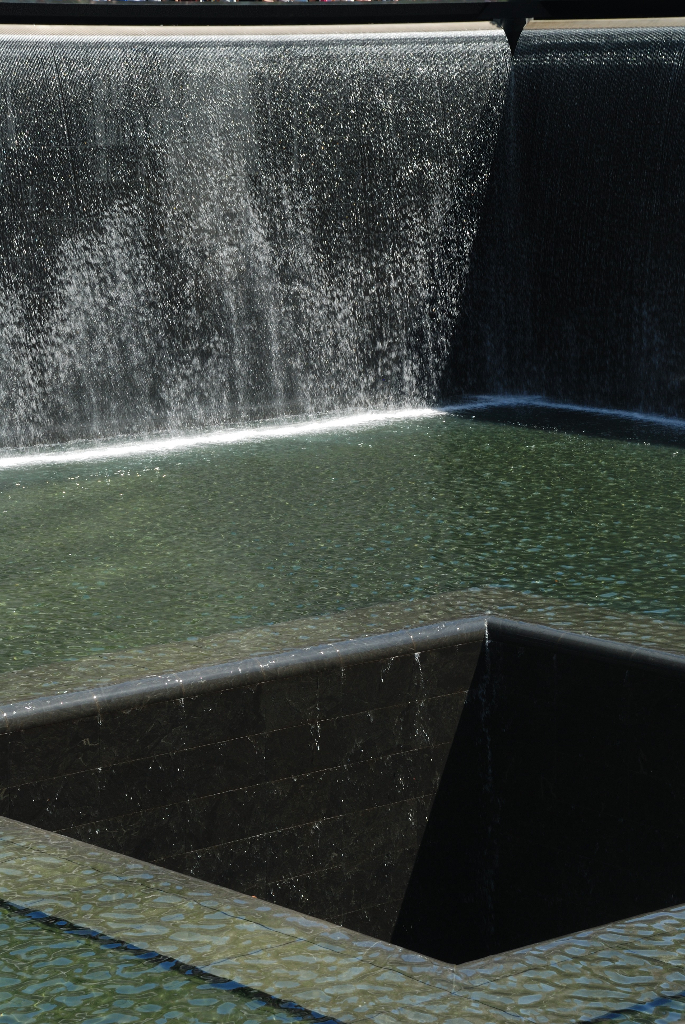
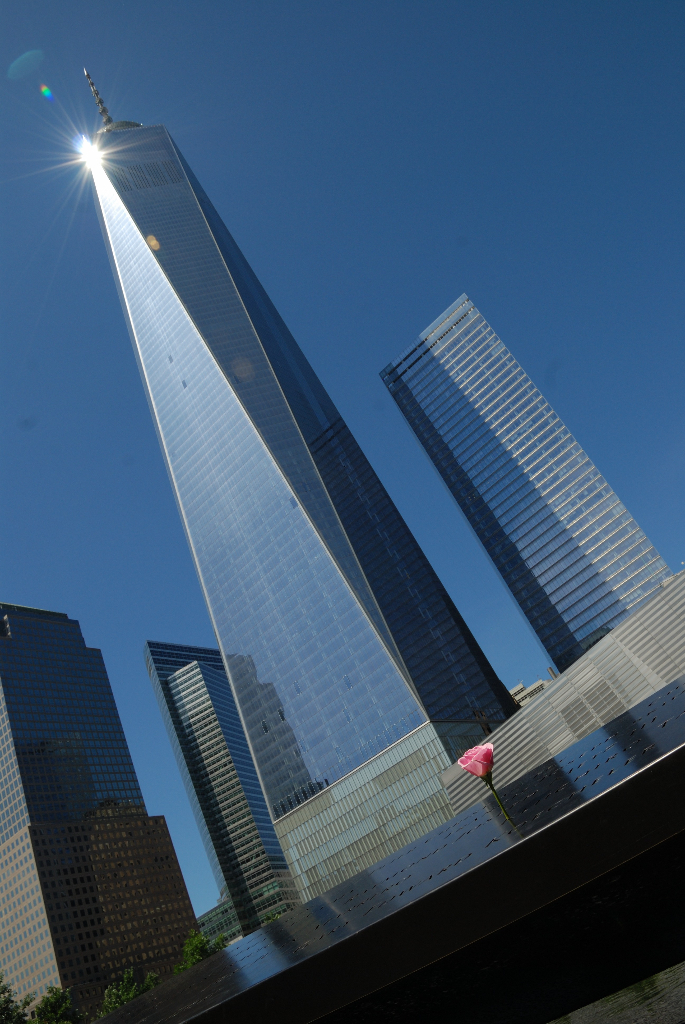
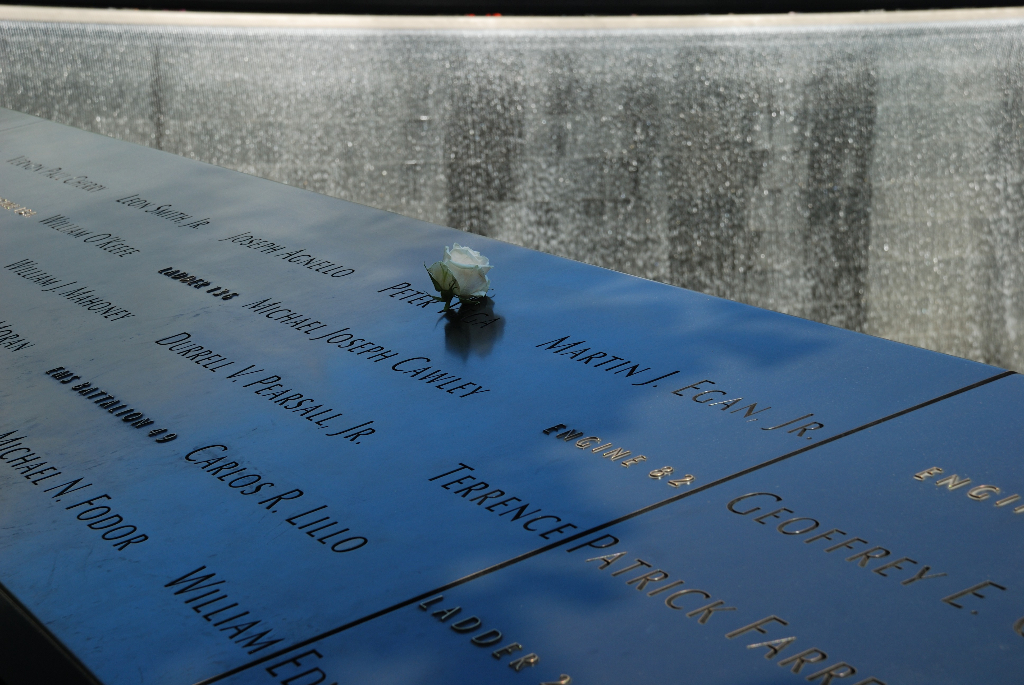
We docked and pottered around Greenwich Village, an older area of New York much more human-scaled than most of the city – predominantly 5-7 storey buildings from the 1800s in wonderful condition. A quick coffee stop at New York’s Rapha Cycle Café then we picked up bikes to continue south, using the greenway along the Hudson to reach the World Trade Centre site (1.9mi). The memorial, comprising two pools in the footprints of the two towers, is very well executed – both haunting and visually captivating.

Left Turn Conflicts
I wasn’t a fan of the left turn arrangements for traffic used along the 8th & 9th Ave cycle tracks, although they were very consistently applied at every intersection, so once you knew what to expect there were no surprises; quite a contrast to London where every junction has a slightly different arrangement to learn the safest way through.
Our third jaunt took us over the Brooklyn Bridge and back (3.1mi) on the shared boardwalk – surprisingly-well-disciplined pedestrians keeping to the correct side of the line demarcating the cycle lane despite it being very busy – then a final trip all the way up 8th Ave to 42nd Street which has a northbound cycle track similar to the southbound one we’d taken on 9th, with the same left turn arrangement.
Ten miles overall, at a relaxed pace other than the last trip which we knew would be close to 30 minutes (where extra charges would kick in – an expensive game at $4 each!). The light phasing is such that lifting the pace slightly gets you through 2-3 extra blocks each time before hitting a red, and we made it just in time (29 minutes)!
Monday – A Lap of Manhattan on the Waterfront Greenway
We hired cheap hybrid bikes for the day (from Bike’n’Roll) to ride the Manhattan Waterfront Greenway, which follows the perimeter of Manhattan island with a few on-street sections where, for various reasons, a waterfront trail hasn’t yet been possible. It encompasses the Hudson River Greenway (running the length of Manhattan on the west side), the Harlem River Greenway on the upper east side, and the East River Greenway along the central and lower east side. The East River and Hudson River greenways connect via Battery Park at the southern tip of Manhattan to complete the loop.
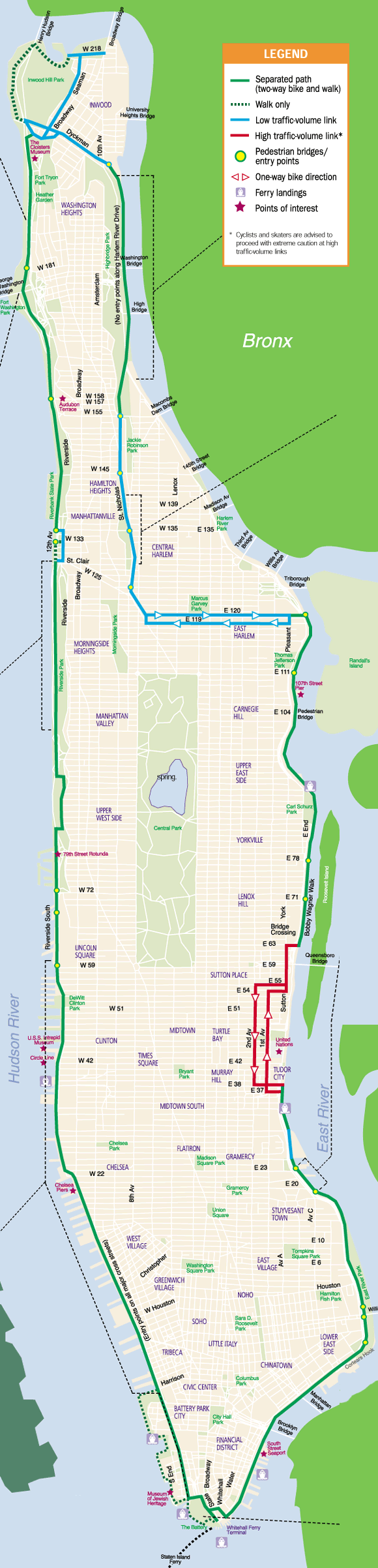
Starting the day at west 42nd Street and heading north, the Hudson River Greenway was excellent – a wide dedicated cycling track with great views over the Hudson and very few cross streets (signal controlled, with green for cycling almost all the time). We made our way to the George Washington Bridge, which looked mightily impressive (if rather like it was made from Meccano) from the underneath, then up a very steep trail to reach the northern extent of Manhattan – Washington Heights – which was surprisingly hilly. I suppose the name should have clued us in to that one! The video (0m45s) below shows a few brief snippets of this excellent trail:

A set of steps (soon to be replaced by a ramp) took us down to a short, well-signed, stretch on-street to cross northern Manhattan and reach the Harlem River Greenway for our trek south. Interestingly, this area felt very unlike a big city; despite being on Manhattan island it was much like anywhere else in the US, a surprise to us both this close to central New York.
The Harlem River Greenway wasn’t nearly as good as the Hudson trail – mostly shared with pedestrians with some protected on-street sections. There weren’t many people, on bike or foot, using this stretch – though mid-morning on a Monday is unlikely to be it’s busiest time.
The trail runs out at 148th street, dead ending into a northbound-only on-road cycle lane. We didn’t see any signs, so we followed our noses (and Open Street Map) through Harlem to 120th, where a couple of blocks east we found the start of the East River Greenway.
An interesting island in the East River caught our eye and, as it had a pedestrian/cycle bridge, we went to investigate. There were horses, a tennis academy, a sports stadium, and some restrooms, but no lunch, so back over the bridge and inland for a slice of pizza and some Peach-O gummy rings. Lunch of champions!
Fresh with energy after our scientifically-proven athletic lunch, we continued south on the East River Greenway until it came to an abrupt end at 63rd Street where the UN Headquarters blocks the trail. Relatively poor signing again hampered us, and this section had busy traffic with little more than sharrows (“share the road arrows”, painted on a normal traffic lane) in the way of bike infrastructure until 36th Street where the trail re-starts. Apparently this section will be much improved in future; the UN are funding $73m of cycling improvements in return for an expansion of their site, which should make a huge and much needed difference.
The trail varied after this, occasionally very narrow but mostly a decent size with dedicated cycling space, running alongside the East River. It frequently uses space under elevated sections of the monstrous FDR Drive, a horrible urban motorway along the east side of Manhattan which wasn’t as horrible underneath as you might expect. Perhaps the joy of having a decent wide dedicated cycle track counterbalanced the downsides of being under a motorway…
As we got towards downtown, there were many more people about, running, walking, skateboarding and cycling – including hand cyclists and recumbents. It wasn’t hard to see why; it was a great space and largely uninterrupted until Battery Park.
At Battery Park we paused at another Bike’n’Roll to pump up – it seems both bikes were ~30psi under recommended, no wonder they felt sluggish! With much easier pedalling, we picked our way through Battery Park and around the southern tip of Manhattan, the trail temporarily lost to a construction area. Once past that, there was a delightful section back on the Hudson where a peaceful pergola structure, entwined with vines and replete with many places to sit, had great views out to Ellis Island and the Statue of Liberty.
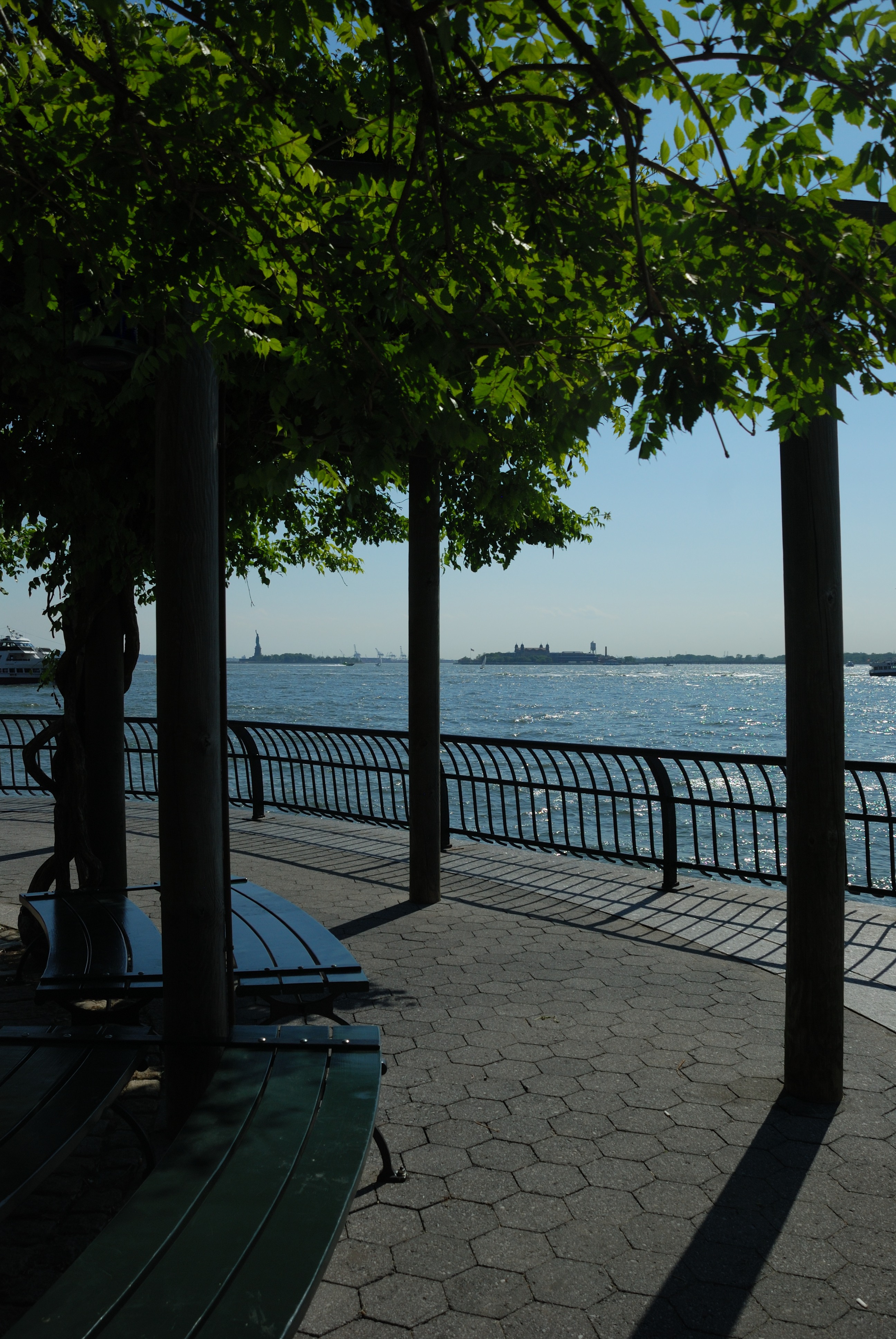
From here, the Hudson River Greenway took us back to our starting point – the southern half being every bit as good as the northern stretch where we’d started. Overall, around 35 miles done at a leisurely pace of ~10mph including much stopping and sightseeing.

For the bike infrastructure geeks, my thoughts on New York’s cycling environment in comparison with London are below – everyone else should save themselves now and head to Part 2 for the lowdown on our adventure on the fantastic American Tobacco Trail in North Carolina and our famous boring stats round-up!
Thoughts on Cycling in New York
My overall impression of cycling in New York is that it was, surprisingly, less stressful than cycling in London. The drivers, while massively aggressive to each other, were uniformly excellent around cyclists (and pedestrians) – giving plenty of space and being very patient, holding well back until there was room to pass. It’s possible that we were just lucky on this front, but in 45 miles of cycling in London (including a Monday evening rush hour) you’d almost certainly get at least one or two idiots, even if “just” following you needlessly closely when there’s no hope of passing.
The infrastructure was mixed – the best of it was truly excellent (better than almost everything in London), and there was a substantial amount of good protected stuff which, again, would put much London provision to shame. There is also a lot of mediocre provision (sharrow claxon, narrow-shared-space claxon, provision-just-running-out-and-dumping-you-at-random claxon) and massive gaps between cycle-friendly streets mean there isn’t, as yet, a comprehensive network.
Also, a one-way system covering pretty much every street with no cycle exceptions made navigating to specific places surprisingly difficult. It would likely get easier if you lived here as you’d learn the directions of the roads (or maybe not: we saw a lot of the locals using the buffers between the cycle track and parked cars as DIY contraflow lanes on 8th & 9th Aves – the fact that there was space for this speaks to the decent width of those lanes!).
Right, off to part 2 with you lot…